
Artificial intelligence is no longer just a futuristic concept—it is actively shaping how businesses operate, make decisions, and innovate. When combined with data analytics, AI becomes a powerful engine capable of uncovering insights that were previously impossible to detect using traditional approaches.
Today, AI and data analytics are revolutionizing industries such as healthcare, finance, e-commerce, cybersecurity, and more. Organizations that embrace AI-powered data analysis are improving efficiency, predicting future trends, and personalizing customer experiences at scale AI and Data Analytics.
In this blog, we’ll explore the top 10 ways AI and data analytics are transforming innovation, and why now is the perfect time to adopt them AI and Data Analytics.
1. Accelerating Decision-Making With Real-Time Analytics
In today’s fast-moving digital world, decisions can no longer take days, weeks, or even months. Businesses operate in competitive markets where customer needs change rapidly, trends evolve every hour, and data grows at an unbelievable pace. Traditional analytics—where data is collected, stored, and analyzed later—can no longer keep up with these demands.
This is where AI-powered real-time analytics becomes a game changer…..https://www.intellicus.com/accelerating-your-business-with-real-time-analytics/
Traditional Analytics vs. Real-Time AI Analytics
Traditional analytics is based primarily on historical data. Businesses collect information, store it in spreadsheets or databases, and then analysts manually interpret the results to identify patterns or insights. This approach works, but it comes with challenges:
- It is slow and time-consuming AI and Data Analytics.
- Insights are often reactive, not predictive.
- Manual analysis risks errors and inconsistency.
- Decisions are based on what happened in the past—not what’s happening now.
AI-driven analytics removes these limitations.
With machine learning and advanced algorithms, AI systems can process massive volumes of structured and unstructured data—social media posts, transactions, customer activity logs, sensor outputs, user clicks, and more—in milliseconds. Instead of relying solely on past data, AI continuously learns and adjusts its predictions based on real-time inputs AI and Data Analytics.
The result? Decisions shift from being reactive to proactive and even autonomous.

How AI Enables Real-Time Decision-Making
The strength of AI in data analytics lies in its ability to interpret data as it flows. Instead of waiting for reports, dashboards, or manual reviews, AI models can:
- Identify anomalies instantly
- Detect emerging trends
- Predict future outcomes
- Trigger automated responses or alerts
This real-time dynamic enables businesses to act at the moment of opportunity—not after it’s passed.
For example:
- A bank can identify a suspicious transaction and block it instantly.
- A retailer can track live demand and adjust product pricing automatically.
- A logistics company can reroute delivery trucks in response to weather or traffic conditions.
This level of responsiveness was not possible with traditional analytics.
Predictive Power: Seeing the Future, Not Just the Past
One of the biggest advantages of AI-powered analytics is its predictive capability.
AI doesn’t just analyze what has happened—it learns patterns and forecasts what’s likely to happen next. Machine learning algorithms can map hidden correlations, detect patterns humans might never see, and refine predictions continuously AI and Data Analytics.
For example:
- Healthcare systems can predict patient health risks and prevent emergencies.
- Financial analysts can estimate market shifts before they occur.
- E-commerce platforms can forecast sales trends, inventory needs, and customer behavior.
This predictive ability gives businesses an edge, allowing them to act before competitors or potential disruptions strike.
Turning Data Into Actionable Intelligence
Data alone has no value unless it leads to meaningful decisions. AI helps transform raw information into clear, actionable insights AI and Data Analytics.
Rather than overwhelming business leaders with complicated reports, AI can simplify complex data into:
- Visual dashboards
- Automated recommendations
- Smart alerts
- Adaptive workflows
Decision-makers no longer need deep technical expertise to understand the data—they simply respond to the insights.
This democratization of data empowers everyone—from executives to frontline employees—to make smarter choices faster.
Boosting Efficiency and Reducing Risk
Real-time AI analytics not only accelerates decision-making but also reduces uncertainty and risk. When insights arrive instantly, organizations can:
- Detect problems before they escalate
- Reduce operational delays
- Forecast demand and optimize resources
- Prevent financial or compliance errors
This leads to better productivity, cost reduction, and improved customer experience.
Real-World Example: Smart Manufacturing
In modern factories, sensors connected to machines constantly stream operational data. AI analyzes this live feed to detect equipment wear, predict failures, and recommend maintenance before breakdowns happen—known as predictive maintenance.
Instead of reacting after machinery fails, manufacturers can prevent downtime entirely. This alone can save millions of dollars annually AI and Data Analytics.
The Impact: Faster, Smarter, More Confident Decisions
With real-time AI analytics, decision-making shifts from slow and uncertain to fast, accurate, and confident.
Businesses can:
- Respond instantly to market changes
- Improve strategy with data-backed predictions
- Create personalized customer experiences
- Scale decisions without scaling human effort
AI empowers organizations to operate with agility and intelligence—something essential in an increasingly digital and competitive world AI and Data Analytics.
2. Enhancing Customer Personalization
Personalization has become one of the most powerful competitive advantages in today’s digital economy. Modern customers expect brands to understand their needs—sometimes even before they express them. This shift in expectations has made AI-powered personalization a critical tool for businesses across industries.
Think for a moment about platforms like Netflix, Amazon, Spotify, or YouTube. These platforms don’t just offer services; they adapt to each user individually. They know what content you enjoy, what products you’re likely to buy, and even when you’re most active AI and Data Analytics.
So how do they do it?
The answer lies in AI-driven customer personalization AI and Data Analytics.
The Power of Predictive Personalization
Traditional marketing used a one-size-fits-all approach. Everyone saw the same ads, the same products, and the same offers. But today, personalization is no longer optional—it’s expected AI and Data Analytics.
AI takes personalization beyond basic segmentation and into the realm of predictive intelligence.
Instead of simply grouping users by age or location, AI analyzes:
- Browsing behaviors
- Search patterns
- Previous purchases
- Time spent on pages
- Viewing or listening habits
- Social interactions
- Device, location, and engagement time
Using machine learning, AI builds a continually evolving profile of each customer. This enables platforms to deliver content, recommendations, or offers that feel tailor-made.
Netflix doesn’t guess—you’re shown recommendations based on millions of data points across users who share similar tastes. The more you interact, the smarter and more accurate the system becomes AI and Data Analytics.

From Static Marketing to Adaptive Experiences
One of the biggest impacts of AI-powered personalization is the transition from static marketing to dynamic, adaptive experiences AI and Data Analytics.
A traditional marketing campaign might push the same message to thousands of customers, regardless of their preferences, interests, or needs AI and Data Analytics.
AI flips that approach.
Instead, every touchpoint becomes personalized:
- Emails change based on user behavior.
- Product recommendations adapt in real time.
- Pricing and promotions can be customized.
- Content layout can shift depending on engagement.
For example:
- If a customer frequently browses fitness products, an e-commerce site may highlight sportswear first.
- If they recently abandoned a cart, AI might trigger a reminder or discount offering just enough incentive to convert AI and Data Analytics.
This dynamic personalization not only improves engagement—it increases conversions AI and Data Analytics.
Emotion and Timing: The Hidden Layers of Personalization
AI personalization goes beyond what customers do—it also considers when and why they do it.
Machine learning models can detect patterns like:
- When a customer is most likely to purchase
- When they revisit content
- When they open emails or notifications
- When they are likely to cancel a subscription
With this insight, timing becomes strategic. AI doesn’t just send personalized content—it delivers it at the perfect moment.
Personalized Ads: Smarter, Not Pushy
Traditional advertising is often intrusive and irrelevant. Think about generic ads that follow you around the internet—they feel repetitive, annoying, and disconnected.
AI-driven advertising, however, is context-aware.
It considers:
- User interests
- Real-time needs
- Purchase intent
- Demographic behavior
- Life events and patterns
For example:
- A user researching travel destinations may receive ads for flights, hotels, and travel gear.
- A student browsing for online courses may see targeted offers for certifications or learning tools AI and Data Analytics.
These ads feel helpful—not disruptive.
Customer Loyalty Through Personalization
One of the biggest advantages of AI personalization is its impact on customer loyalty AI and Data Analytics.
When customers feel understood, they are more likely to:
✔ Return
✔ Spend more
✔ Stay longer
✔ Recommend the brand
Studies show that customers who receive personalized experiences are more than twice as likely to become long-term, repeat buyers.
This is because personalization creates an emotional connection—customers feel valued, not generalized AI and Data Analytics.
Real-World Example: Spotify
Spotify doesn’t just recommend music—it shapes listening habits. Playlists like Discover Weekly and Daily Mix are built using deep learning models trained on billions of data points from users worldwide AI and Data Analytics.
Spotify considers:
- Song tempo
- Genre preferences
- Skip rate
- Mood patterns
- Listening time
- Social shares
Over time, the recommendations become incredibly accurate—so accurate that users trust the platform to guide their discovery process.
That trust is the foundation of loyalty.
The Future of Personalization: Hyper-Individual Experiences
As AI continues to evolve, personalization will go even deeper.
Future AI systems may:
- Predict needs before they’re expressed
- Offer fully personalized digital environments
- Create adaptive interfaces unique to each individual
- Tailor physical retail experiences using biometric data
We are moving from personalization to hyper-personalization—where every interaction feels like a one-on-one conversation with the brand.
3. Improving Fraud Detection and Cybersecurity
In a world where digital transactions, online banking, remote work, and cloud computing have become the norm, cybersecurity threats are rising faster than ever. Cybercriminals are more sophisticated, and traditional rule-based security systems simply can’t keep up. They rely on predefined conditions and manual monitoring, which means they often detect threats only after damage has occurred AI and Data Analytics.
This reactive approach is no longer enough.
Artificial intelligence and data analytics are now transforming cybersecurity from a defensive operation into a proactive, intelligent security system capable of predicting, detecting, and preventing threats in real time AI and Data Analytics.
From Reactive to Predictive Security
Historically, cybersecurity relied on static rules: if a pattern matched a known threat signature, it was blocked. While this worked in the past, cybercrime today evolves too rapidly. Hackers constantly tweak malware, change attack methods, and exploit weaknesses faster than systems can be manually updated AI and Data Analytics.
AI, however, doesn’t depend solely on known threats.
Instead, machine learning models learn from millions of data points—user behavior, device fingerprints, login history, network traffic, and transaction patterns—and use this knowledge to detect unusual or suspicious behavior, even if it’s never been seen beforeb AI and Data Analytics.
This shift from rule-based security to anomaly-based detection is what makes AI a game changer.
How AI Detects Fraud and Threats
AI-powered fraud detection works by continuously analyzing behavior patterns and comparing them against normal user actions. When something doesn’t align with expected behavior, the system flags it—and in many cases, intervenes automatically.
Examples include:
- A sudden login attempt from a new country
- A user transferring unusually large amounts of money
- Repeated failed password attempts
- Access requests during abnormal hours
- Transactions that don’t match historical spending patterns
These behaviors may seem harmless individually—but combined, they form a digital footprint that AI recognizes as potential fraud.

Pattern Recognition and Machine Learning
At the core of AI cybersecurity is pattern recognition.
Machine learning algorithms continuously observe how users behave over time. By understanding what “normal” looks like, AI can instantly detect when something feels off.
For instance:
- If you log in daily from the same device and location, the system recognizes that pattern
- But if a login occurs from another continent only minutes later, AI identifies impossible travel and blocks the attempt
Traditional tools would miss this without manual checks—but AI catches it instantly.
Real-Time Threat Response
Perhaps the most powerful advantage of AI in cybersecurity is speed.
Cyber attacks happen in milliseconds. The longer a breach goes undetected, the more damage it can cause—data theft, financial loss, ransomware infections, identity fraud, or system compromise.
With AI, responses are instant:
- Suspicious activity can trigger immediate alerts
- Fraudulent transactions can be automatically declined
- Sessions can be terminated based on behavior anomalies
- Access can be blocked or challenged with multi-factor authentication
There is no waiting for human review—AI acts the moment a threat appears.
Industry Adoption: From Banking to Insurance
Many industries now rely heavily on AI to secure data and operations:
✔ Banking and FinTech
Banks face growing cyber threats ranging from stolen credentials to money laundering. AI helps detect suspicious transfers, account anomalies, and identity theft more effectively than manual review.
For example, credit card companies use machine learning to detect fraud in real time—sometimes before the customer even realizes their information was stolen.
✔ Insurance
Insurance fraud costs billions globally. AI models analyze claim history, customer behavior, and document authenticity to flag potential manipulation or false claims.
✔ Online Platforms and E-Commerce
Platforms like Amazon, PayPal, and Stripe use AI to detect fake accounts, prevent chargeback fraud, and secure user data in real time.
Cybersecurity Risk Prevention With AI
AI doesn’t just respond to threats—it helps prevent them.
Using predictive analytics, AI can:
- Identify system vulnerabilities
- Forecast potential attack routes
- Detect early signs of ransomware or phishing attempts
- Assess security risk levels across networks
This shift toward predictive cybersecurity gives organizations time to strengthen defenses before an attack occurs.
Reducing Human Errors and Increasing Precision
Human error remains one of the biggest cybersecurity weaknesses—weak passwords, unsafe downloads, mistakenly shared links, or phishing attacks.
AI reduces reliance on manual judgment and automates threat analysis with greater accuracy. Machine learning models can detect patterns humans may never notice, especially within massive datasets.
This not only improves accuracy but also reduces false alarms—ensuring IT teams focus only on genuine threats.
The Future: Autonomous Cybersecurity
As AI continues to advance, the future of cybersecurity will move toward fully autonomous systems capable of:
- Self-learning
- Automatic vulnerability patching
- Adaptive defense strategies
- AI-generated security policies
- Automated threat hunting
Instead of humans reacting to threats, AI will continuously monitor, protect, and adapt—creating smarter, more resilient digital environments.
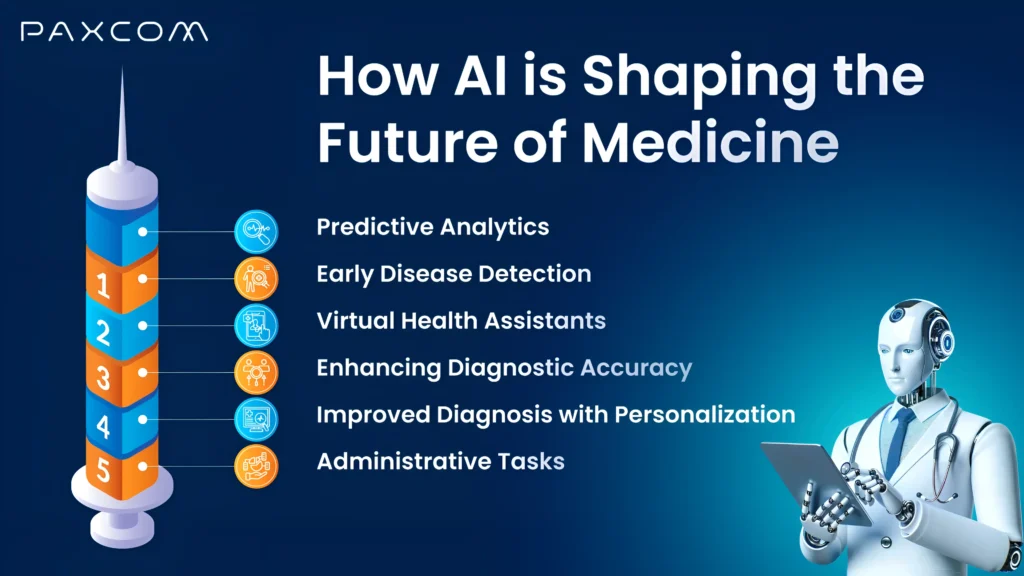
4. Transforming Healthcare With Predictive Insights
AI-driven data analytics enables doctors to diagnose diseases earlier and more accurately.
Applications include:
- Predicting patient health risks
- Personalized treatment plans
- Faster drug discovery
- Medical imaging analysis
From detecting cancer using image recognition to monitoring patient vitals with wearables, AI is saving lives.
5. Optimizing Supply Chain and Logistics
AI helps companies forecast demand, manage inventory, and streamline operations.
With real-time tracking and predictive modeling, businesses can reduce delays, optimize delivery routes, and cut operational costs. Companies like Amazon and DHL are leading examples of AI-enabled logistics innovation.
6. Increasing Productivity With Automation
Automation powered by AI eliminates repetitive tasks and allows workers to focus on strategy and creativity.
Examples include:
- Automated reporting
- AI-driven customer support and chatbots
- Intelligent HR screening tools
- Robotic process automation (RPA)
This leads to reduced errors, faster output, and more efficient workflows.
7. Unlocking Predictive and Prescriptive Analytics
AI doesn’t just describe what happened—it predicts what might happen and suggests what action to take.
This has become crucial for:
- Stock market forecasting
- Price optimization
- Risk management
- Business planning
Predictive analytics gives companies foresight, while prescriptive analytics provides strategic recommendations.
8. Enabling Smarter Research and Innovation
Whether it’s scientific research, academic studies, or R&D, AI has become an essential research partner.
AI models can analyze complex datasets, identify patterns, and test hypotheses in ways humans cannot.
This accelerates innovation in biotechnology, climate science, engineering, and materials research.
9. Supporting Business Intelligence and Strategy
AI enhances modern Business Intelligence (BI) tools by offering deeper insights, automated dashboards, and intelligent forecasting models.
With AI-powered analytics platforms like Tableau, Power BI, and Google Cloud AI Platform, decision-makers now have strategic insights at their fingertips—not just raw data.
10. Fueling Competitive Advantage and Digital Transformation
Businesses using AI and data analytics outperform those that don’t.
Why?
Because AI transforms data into smart value:
- Faster innovation
- Improved efficiency
- Better customer experiences
- Reduced operational costs
- Lower risks
Organizations adopting AI today are building a strong foundation for the future digital economy.
Final Thoughts: The Future Belongs to AI-Driven Data Analytics
AI and data analytics are no longer optional—they are essential. As global data continues to grow exponentially, the organizations that implement AI-powered data analysis will lead the next wave of digital transformation.
From predictive insights to automation and real-time intelligence, AI is reshaping what is possible in modern research, business, and technology…Blogs
The question now isn’t “Should organizations adopt AI?”
It’s “How fast can they integrate it?”